
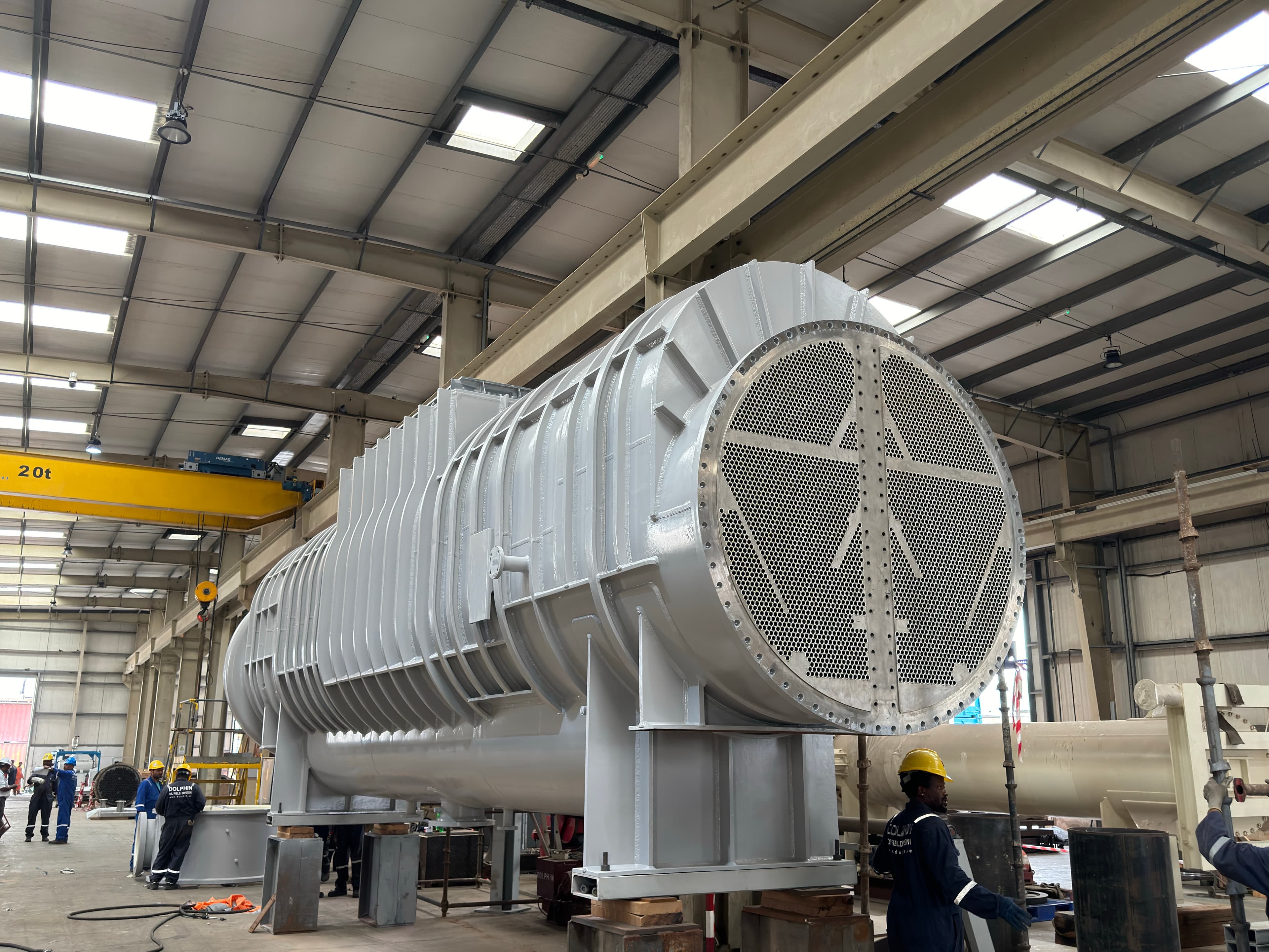
Shell & Tube Heat Exchangers
TEMA-compliant, ASME U-stamped shell & tube heat exchangers designed, fabricated and tested in Abu Dhabi — the workhorse of process heat exchange, built for service worldwide.
Why This
Matters
The wrong specification here doesn't show up on day one — it shows up as downtime, contamination or wasted energy later.
Asset protection
An undersized or mis-specified exchanger runs hot, fouls fast and fails early — taking pumps, seals and downstream equipment with it. Replacing it mid-campaign means an unplanned shutdown, not a scheduled one.
Process integrity
Tube leaks cross-contaminate product and utility streams. Correct TEMA type, tubesheet design and weld quality are what stand between two fluids — get any one wrong and the exchanger becomes the point of failure for the whole process.
Operational efficiency
Every degree of lost approach temperature is bought back with fuel or power. Precision thermal design, verified in HTRI before fabrication, pays for the exchanger many times over its operating life.
Where It's
Used
Shell & Tube Heat Exchangers in service — sector by sector, application by application.
Oil & Gas
Crude preheat trains, gas coolers, reboilers and overhead condensers to API 660.
View Oil & GasPetrochemicals
Process interchangers, reboilers and condensers for crackers and polymer units.
View PetrochemicalsPower & Energy
Lube oil coolers, closed cooling water exchangers and feedwater heaters.
View Power & EnergyWater & Desalination
Brine heaters and interstage heat recovery in titanium and Cu-Ni.
View Water & DesalinationChemical Manufacturing
Corrosive-service exchangers in duplex, alloy and clad construction.
View Chemical ManufacturingMarine & Offshore
Seawater-cooled process and utility exchangers with class documentation.
View Marine & OffshoreHow It Works
A shell & tube heat exchanger transfers heat between two fluids without mixing them. One fluid flows through a bundle of tubes; the other flows over those tubes inside a cylindrical shell.
- 1
The tube-side fluid enters a channel head and is distributed into hundreds of parallel tubes.
- 2
The shell-side fluid flows across the outside of the tube bundle, guided by baffles that maximise contact and turbulence.
- 3
Heat conducts through the tube walls from the hot fluid to the cold one — no direct contact ever occurs.
- 4
Baffle spacing, tube pitch and pass count are tuned so both streams exit at their specified temperatures.
- 5
Gaskets, tubesheets and welded joints contain each fluid at pressures that can exceed 100 bar.
Configurations
We Offer
Every variant Dolphin builds — each engineered for a specific duty, not a catalogue default.
Fixed Tubesheet (TEMA BEM)
- Best For
- Clean shell-side service with modest temperature differentials.
- Advantage
- Lowest cost per unit surface; maximum tube count in a given shell.
U-Tube (TEMA BEU)
- Best For
- High temperature differentials and thermal cycling duties.
- Advantage
- Bundle expands freely — no expansion joint; bundle is removable for shell-side cleaning.
Floating Head (TEMA AES/AET)
- Best For
- Fouling fluids on both sides needing full mechanical cleaning.
- Advantage
- Fully removable, fully cleanable bundle — the refinery standard for dirty services.
Kettle Reboiler (TEMA AKT)
- Best For
- Vaporising duties — column reboilers and steam generators.
- Advantage
- Enlarged shell provides vapour disengagement space for stable boiling.
How to
Choose
| Criterion | Guidance |
|---|---|
| Thermal duty | Heat load, flow rates and terminal temperatures set the required surface area — confirmed in HTRI, never by rule of thumb. |
| Fouling tendency | Dirty services need removable bundles (floating head or U-tube) and access for mechanical cleaning. |
| Pressure & temperature | Design conditions drive shell thickness, flange rating and material class under ASME Section VIII. |
| Fluid compatibility | Chlorides, H₂S and acids dictate metallurgy — from carbon steel to duplex, titanium or clad plate. |
| TEMA class | Class R for severe petroleum service, Class C for general process, Class B for chemical duty. |
| Maintenance strategy | Match tube-side/shell-side allocation and bundle type to how the plant actually cleans and inspects. |
Key
Benefits
What sets shell & tube heat exchangers from Dolphin apart, in specific and measurable terms.
- 01
Certified fabrication
ASME U-stamped fabrication with full material traceability to EN 10204 3.1/3.2.
- 02
Verified thermal design
In-house HTRI thermal design — guaranteed performance, not catalogue guesses.
- 03
High-duty rated
Design pressures beyond 100 bar and temperatures beyond 500°C.
- 04
Metallurgy range
From carbon steel to duplex, titanium, and clad construction.
- 05
Drop-in replacement
Replacement bundles reverse-engineered from existing units.
- 06
Local fabrication speed
UAE fabrication cuts lead time by months versus overseas suppliers.
Technical
Specifications
Design codes, materials and testing scope confirmed for every shell & tube heat exchangers order.
| Design code | ASME Section VIII Div.1 (U-stamp) |
| Thermal standard | TEMA Class R / C / B · API 660 |
| Design software | HTRI Xchanger Suite · PV Elite · ANSYS |
| Materials | CS · SS 304/316 · Duplex · Cu-Ni · Titanium · Clad plate |
| Tube diameter range | 12.7 mm – 50.8 mm OD |
| Shell diameter | Up to 3,000 mm |
| Testing | Hydrostatic · Pneumatic · RT/UT/PT/MT NDT · PMI |
| Documentation | Full QA dossier, weld maps, material certs, U-1 data reports |
Why Dolphin for
Shell & Tube Heat Exchangers
ADNOC-approved, ICV+ certified
Qualified to the world’s most demanding procurement standards — one of ~70 ICV+ companies in the UAE.
Design-to-delivery under one roof
HTRI thermal design, ASME fabrication, NDT and testing all happen in our Mussafah facility — one accountable party.
40+ years of service history
Four decades of exchangers operating in some of the harshest conditions on earth inform every material and design decision we make.
Frequently Asked Questions
For fouling on both sides, a floating head (AES/AET) allows full bundle removal and mechanical cleaning. If only the tube side fouls, a fixed tubesheet with cleanable straight tubes is more economical.
Yes. We reverse-engineer from the physical unit and nameplate data, verify thermal performance in HTRI, and fabricate a dimensionally identical drop-in replacement.
Titanium, super duplex, and 90/10 copper-nickel are our standard recommendations, selected by chloride level, temperature and velocity.
Yes. Dolphin Group holds ASME U and R Certificates of Authorization, so new construction and repairs are code stamped with full data reports.
Typically 8–16 weeks depending on size and metallurgy — significantly faster than overseas fabrication once shipping and customs are counted.
Yes. Spare bundles are a standard scope, and we hold dimensional records of every bundle we build for fast repeat orders.
Yes. We design and fabricate to API 660 supplementary requirements alongside TEMA Class R for petroleum service.
Send your datasheet, TEMA sheet or existing unit details through our RFQ form or to connect@dolphin.ae. We typically respond within two working days.
Talk to an Engineer About Shell & Tube Heat Exchangers
Send your duty requirements or existing datasheet — our engineers will confirm the right configuration and get you a quote.