
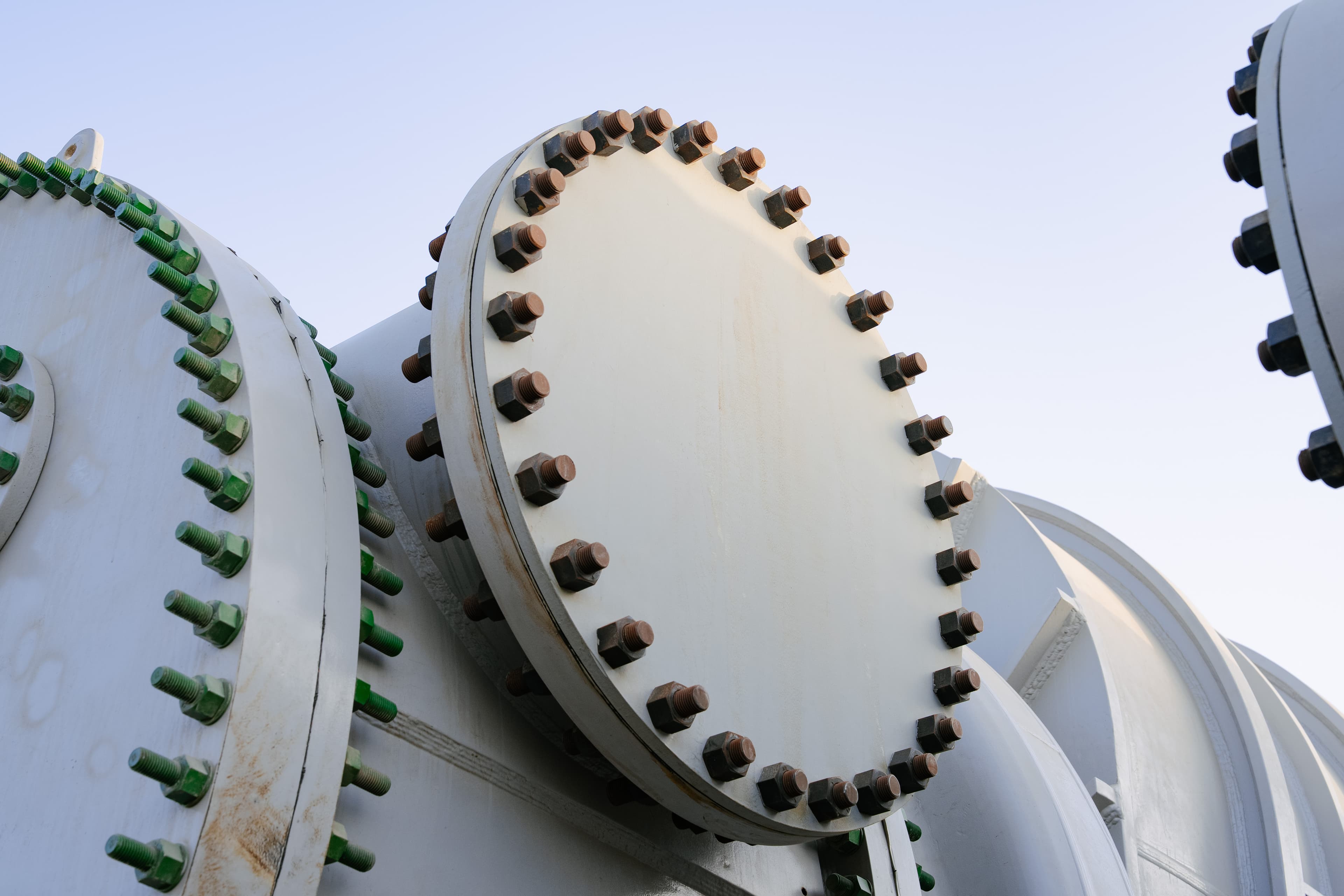
Plate Heat Exchangers
Gasketed, brazed and welded plate heat exchangers delivering maximum heat exchange in minimum footprint — supplied, serviced and regasketed in the UAE.
Why This
Matters
The wrong specification here doesn't show up on day one — it shows up as downtime, contamination or wasted energy later.
Asset protection
Hard-worked plate packs fail through gasket ageing and plate fatigue — undetected, a single cracked plate cross-contaminates the whole circuit. Regular regasketing catches this before it becomes a process incident.
Process integrity
Wrong plate material or gasket elastomer for the fluid means early failure; correct selection is chemistry, not catalogue shopping. The same duty in two different fluids can call for two completely different plate packs.
Operational efficiency
Close temperature approaches (down to 1°C) recover heat that shell & tube geometry physically cannot — wasted approach is wasted energy, paid for every hour the plant runs.
Where It's
Used
Plate Heat Exchangers in service — sector by sector, application by application.
Data Centers
Free-cooling economiser loops and chilled water isolation exchangers.
View Data CentersFood & Beverage
Pasteurisation, CIP heating and product cooling with food-grade gaskets.
View Food & BeverageMarine & Offshore
Compact central coolers where footprint and weight are critical.
View Marine & OffshorePower & Energy
Closed cooling water and lube oil duty with titanium seawater plates.
View Power & EnergyPetrochemicals
Process interchange duty where close approach saves steam.
View PetrochemicalsFacilities Management
Chilled-water plate exchangers and heat reclaim for commercial cooling plants.
View Facilities ManagementHow It Works
A plate heat exchanger passes two fluids through alternating channels formed between thin corrugated metal plates, transferring heat through the plates at very high efficiency.
- 1
Corrugated plates are stacked into a pack; gaskets or welds seal alternating channels for each fluid.
- 2
Hot and cold fluids flow in opposite directions through adjacent channels.
- 3
The corrugation induces turbulence at low velocity, producing very high heat exchange coefficients.
- 4
The full pack is compressed in a frame; capacity can be changed later by adding or removing plates.
Configurations
We Offer
Every variant Dolphin builds — each engineered for a specific duty, not a catalogue default.
Gasketed Plate & Frame
- Best For
- General duty where cleanability and future expansion matter.
- Advantage
- Fully openable for inspection; capacity adjustable by adding plates.
Brazed Plate
- Best For
- Compact HVAC and refrigeration duties with clean fluids.
- Advantage
- No gaskets, minimal footprint, economical at small sizes.
Welded / Semi-welded
- Best For
- Aggressive chemicals or refrigerants unsuited to gaskets.
- Advantage
- Gasket-free process side handles fluids elastomers cannot.
Free-flow / Wide-gap
- Best For
- Fibrous or particulate-laden media (pulp, syrups, wastewater).
- Advantage
- Open channels resist plugging where standard plates choke.
How to
Choose
| Criterion | Guidance |
|---|---|
| Fluid chemistry | Plate metallurgy (SS316, titanium, alloy) and gasket elastomer (NBR, EPDM, Viton) are chosen against the actual fluid analysis. |
| Temperature approach | PHEs achieve 1–2°C approaches — pick a PHE when heat recovery economics matter. |
| Pressure & temperature limits | Gasketed units typically to 25 bar / 180°C; beyond that, welded or shell & tube designs take over. |
| Fouling and particulates | Standard channels are narrow — dirty media need wide-gap plates or strainers upstream. |
| Service strategy | If in-place cleaning matters, gasketed frames win; if compactness rules, brazed wins. |
Key
Benefits
What sets plate heat exchangers from Dolphin apart, in specific and measurable terms.
- 01
Higher heat exchange rates
Three to five times the heat exchange coefficient of shell & tube in the same duty.
- 02
Close temperature approach
Down to 1°C for maximum heat recovery.
- 03
Compact footprint
Up to 80% smaller footprint and lighter installed weight.
- 04
Expandable in-frame
Capacity expandable by adding plates — no replacement capex.
- 05
UAE-held stock
Plate and gasket stock for major brands cuts service downtime to days.
- 06
In-country service
Full regasketing, plate cleaning and integrity testing.
Technical
Specifications
Design codes, materials and testing scope confirmed for every plate heat exchangers order.
| Plate materials | SS 304/316 · Titanium · SMO 254 · Hastelloy |
| Gasket materials | NBR · EPDM · HNBR · FKM (Viton) |
| Design pressure | Up to 25 bar (gasketed) · higher for brazed/welded |
| Design temperature | -30°C to +180°C (gasketed) |
| Standards | ASME Section VIII Div.1 · PED on request |
| Service | Regasketing · chemical plate cleaning · dye-penetrant crack testing |
Why Dolphin for
Plate Heat Exchangers
Multi-brand service capability
We regasket and recondition all major plate exchanger brands with UAE-held stock — no waiting on overseas OEM service slots.
Engineering-led selection
Every unit is thermally rated against your actual duty and fluid chemistry, not picked from a catalogue table.
ICV+ and ADNOC approval
Procurement-ready for the world’s most demanding operators, with 40+ years of service behind every recommendation.
Frequently Asked Questions
When footprint, close temperature approach, or heat recovery economics dominate, and design conditions stay within roughly 25 bar and 180°C with reasonably clean fluids.
Yes — we regasket, clean and crack-test all major brands, with plate and gasket stock held in the UAE.
Typically every 5–7 years in moderate service, sooner at high temperature. Hardened, compressed gaskets that leak on restart are the classic sign.
Usually yes — frames are commonly sized with spare capacity, so plates can be added without replacing the frame.
Titanium is the standard for seawater duty; SS316 fails on chlorides at Gulf temperatures.
Dye-penetrant testing of the opened pack, or on-line by monitoring cross-contamination; we provide both workshop and site testing.
Yes — FDA-compliant elastomers for pasteurisers and food processing duties are standard scope.
Share the unit nameplate details and duty through our RFQ form or connect@dolphin.ae — service crews mobilise from Mussafah within days.
Talk to an Engineer About Plate Heat Exchangers
Send your duty requirements or existing datasheet — our engineers will confirm the right configuration and get you a quote.