
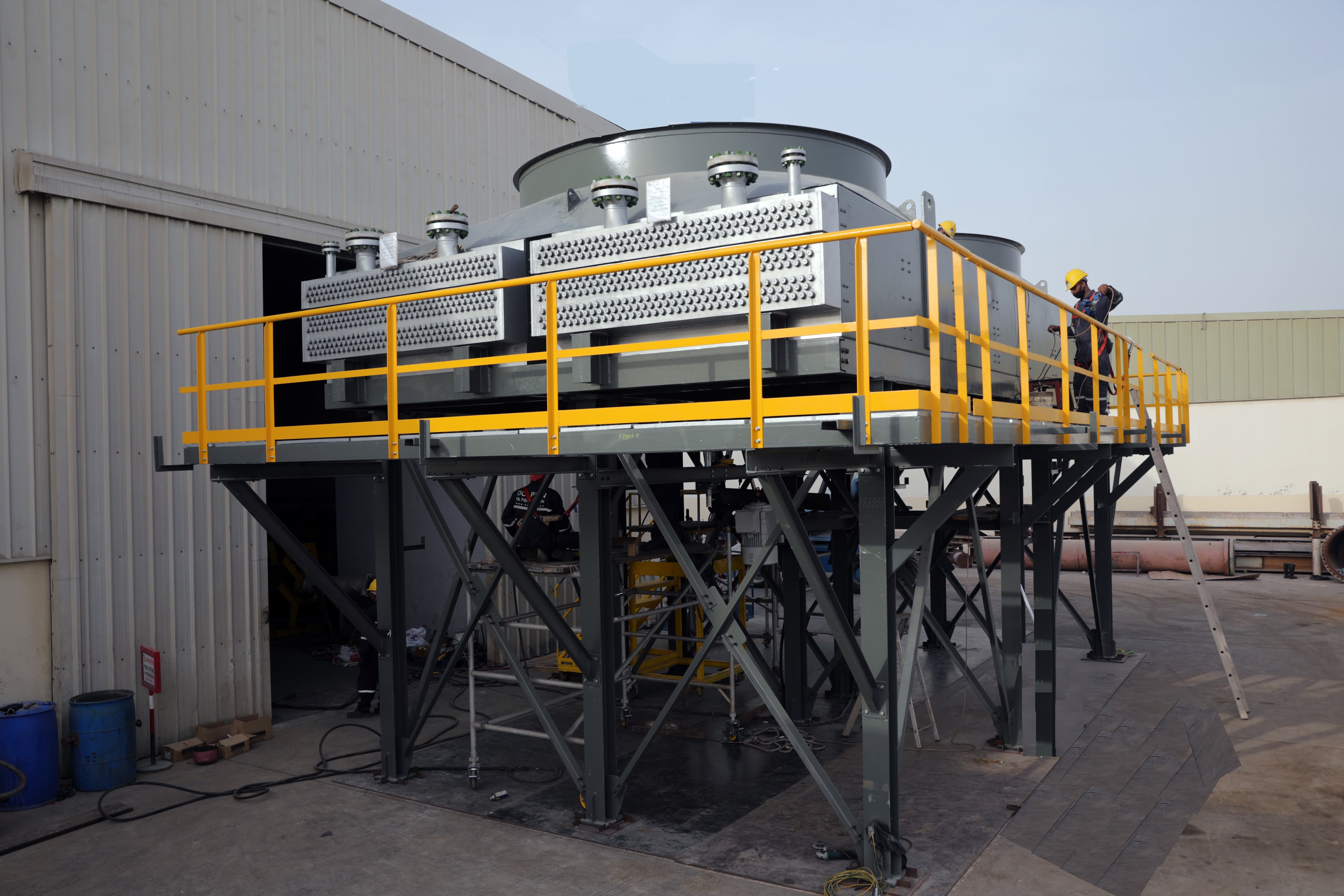
Air-Cooled Heat Exchangers
API 661 fin fan coolers engineered for 50°C+ Gulf ambients — where water is scarce and heat rejection is mission-critical.
Why This
Matters
The wrong specification here doesn't show up on day one — it shows up as downtime, contamination or wasted energy later.
Asset protection
Coolers rated for 35°C ambient collapse in a Gulf summer — process temperatures climb and trips follow exactly when demand peaks. Ambient design margin is not optional in this region, it is the whole spec.
Process integrity
Vibration, fan failure and fouled fins silently erode capacity until the exchanger becomes the plant bottleneck. None of these show up on a control-room screen until duty has already been lost.
Operational efficiency
Where water is scarce or expensive, air cooling removes the cooling-tower water bill entirely — if the thermal design is honest about ambient. An optimistic design temperature undoes that saving the first hot afternoon.
Where It's
Used
Air-Cooled Heat Exchangers in service — sector by sector, application by application.
Oil & Gas
Gas compression aftercooling, condensing and process cooling to API 661.
View Oil & GasPower & Energy
Auxiliary cooling and dry cooling where water is unavailable.
View Power & EnergyPetrochemicals
Overhead condensers and product coolers in water-constrained plants.
View PetrochemicalsData Centers
Dry coolers and condenser duty engineered for peak Gulf ambients.
View Data CentersSteel & Metallurgy
Closed-circuit cooling of furnace and casting water loops.
View Steel & MetallurgyFacilities Management
Dry coolers and condenser duty for building chiller plants at peak ambient.
View Facilities ManagementHow It Works
An air-cooled heat exchanger rejects process heat directly to atmosphere: fans move ambient air across finned tubes carrying the hot fluid — no cooling water required.
- 1
Hot process fluid enters horizontal finned tube bundles arranged in bays.
- 2
Axial fans force (or induce) ambient air across the finned surface.
- 3
Fins multiply the air-side surface area by 15–20 times, compensating for air’s poor heat exchange.
- 4
Fan pitch, speed control or louvres regulate outlet temperature as ambient swings from winter nights to 50°C summer afternoons.
Configurations
We Offer
Every variant Dolphin builds — each engineered for a specific duty, not a catalogue default.
Forced Draft
- Best For
- General process duty; easiest fan and drive maintenance.
- Advantage
- Fans below the bundle work in cool air — lower power and longer life.
Induced Draft
- Best For
- Duties needing even airflow and recirculation protection.
- Advantage
- Better air distribution and less hot-air recirculation in still conditions.
Replacement Bundles
- Best For
- Re-rating or life-extending existing cooler banks.
- Advantage
- New bundles into existing structures — a fraction of full replacement cost.
How to
Choose
| Criterion | Guidance |
|---|---|
| Design ambient temperature | The single most abused number in Gulf cooler design — we size for real summer peaks, not global catalogue defaults. |
| Process outlet temperature | Approach to ambient sets bundle size; tight approaches in summer need honest margins. |
| Fin type and material | Embedded G-fin for high temperature, extruded for coastal corrosion, L-foot for economy. |
| Noise limits | Fan selection and tip speed are engineered against site noise constraints. |
| Winterisation / turndown | Variable pitch, VFDs or louvres keep outlet temperature stable across a 40°C ambient swing. |
Key
Benefits
What sets air-cooled heat exchangers from Dolphin apart, in specific and measurable terms.
- 01
Zero water consumption
No cooling tower, no chemistry, no blowdown.
- 02
Honest ambient rating
API 661 design rated for 50°C+ Gulf ambient conditions.
- 03
Structure-matched replacement
Replacement bundles re-rated and fabricated for existing structures.
- 04
Certified headers
ASME-stamped headers with full NDT and hydrotest documentation.
- 05
Environment-matched fins
Fin metallurgy selected for coastal and industrial atmospheres.
- 06
Local fabrication speed
Locally fabricated — weeks of lead time saved versus import.
Technical
Specifications
Design codes, materials and testing scope confirmed for every air-cooled heat exchangers order.
| Design code | API 661 · ASME Section VIII Div.1 |
| Tube materials | CS · SS · Duplex · Ti (headers to match) |
| Fin types | Embedded (G) · Extruded · L-foot · Knurled |
| Fan diameter | Up to 5.5 m, forced or induced draft |
| Control options | Auto-variable pitch · VFD · Louvres |
| Design software | HTRI ACE · PV Elite |
Why Dolphin for
Air-Cooled Heat Exchangers
Designed for this climate
Forty years of Gulf operation means our ambient design assumptions are real — your cooler performs in August, not just on the datasheet.
Bundle replacement specialists
We reverse-engineer existing bundles and re-rate them for changed duties, reusing structures and drives.
ADNOC-approved fabrication
API 661 fabrication under ASME U-stamp at Mussafah with ICV+ contribution for your procurement scoring.
Frequently Asked Questions
We recommend 50°C dry-bulb minimum for inland UAE sites, with performance checked at the true summer peak — not the 35–40°C defaults common in imported designs.
Yes — we measure the existing bay, re-rate thermally for current duty, and fabricate drop-in bundles that reuse your structure, fans and drives.
Forced draft is cheaper to maintain and the usual default; induced draft gives better air distribution and less recirculation for tight approach duties.
Extruded aluminium fins fully sheath the tube and resist coastal corrosion best; embedded fins suit higher temperatures inland.
Variable-pitch fans, VFDs or louvres — often combined — hold outlet temperature stable across large ambient swings.
Both: complete API 661 units with structure, fans and drives, or bundles-only for retrofit.
Low-noise fan selections routinely meet 85 dB(A) at 1 m, with lower targets achievable by fan choice and tip speed.
Send bundle dimensions or the original datasheet through our RFQ form; a site measurement visit can be arranged from Mussafah within days.
Talk to an Engineer About Air-Cooled Heat Exchangers
Send your duty requirements or existing datasheet — our engineers will confirm the right configuration and get you a quote.