Hydrojetting & Tube Cleaning
High-pressure water jetting to 2,800 bar that restores fouled exchangers to design performance — without damaging the metal underneath.
Why This
Matters
The wrong specification here doesn't show up on day one — it shows up as downtime, contamination or wasted energy later.
Asset protection
Mechanical rodding and aggressive chemicals damage tube surfaces; water jetting removes deposits without metal loss, preserving wall thickness and extending the bundle's remaining service life.
Process integrity
Partially blocked tubes create local velocities and dead zones that accelerate corrosion and under-deposit attack — the fouling that is left behind does more damage than the fouling that is removed.
Operational efficiency
A fouled exchanger can lose half its duty — heat you then buy back as fuel. Cleaning is the cheapest energy project in the plant, with payback measured in weeks rather than years.
Where It's
Used
Hydrojetting & Tube Cleaning in service — sector by sector, application by application.
Oil & Gas
Preheat train and cooler cleaning during turnarounds.
View Oil & GasPower & Energy
Condenser and cooler tube cleaning during outages.
View Power & EnergyPetrochemicals
Polymer and coke removal from process exchangers.
View PetrochemicalsWater & Desalination
Scale removal from brine heaters and evaporator tubes.
View Water & DesalinationSteel & Metallurgy
Cooling circuit and gas cooler descaling.
View Steel & MetallurgyPulp & Paper
Fibre and scale removal from liquor and condensate exchangers.
View Pulp & PaperHow It Works
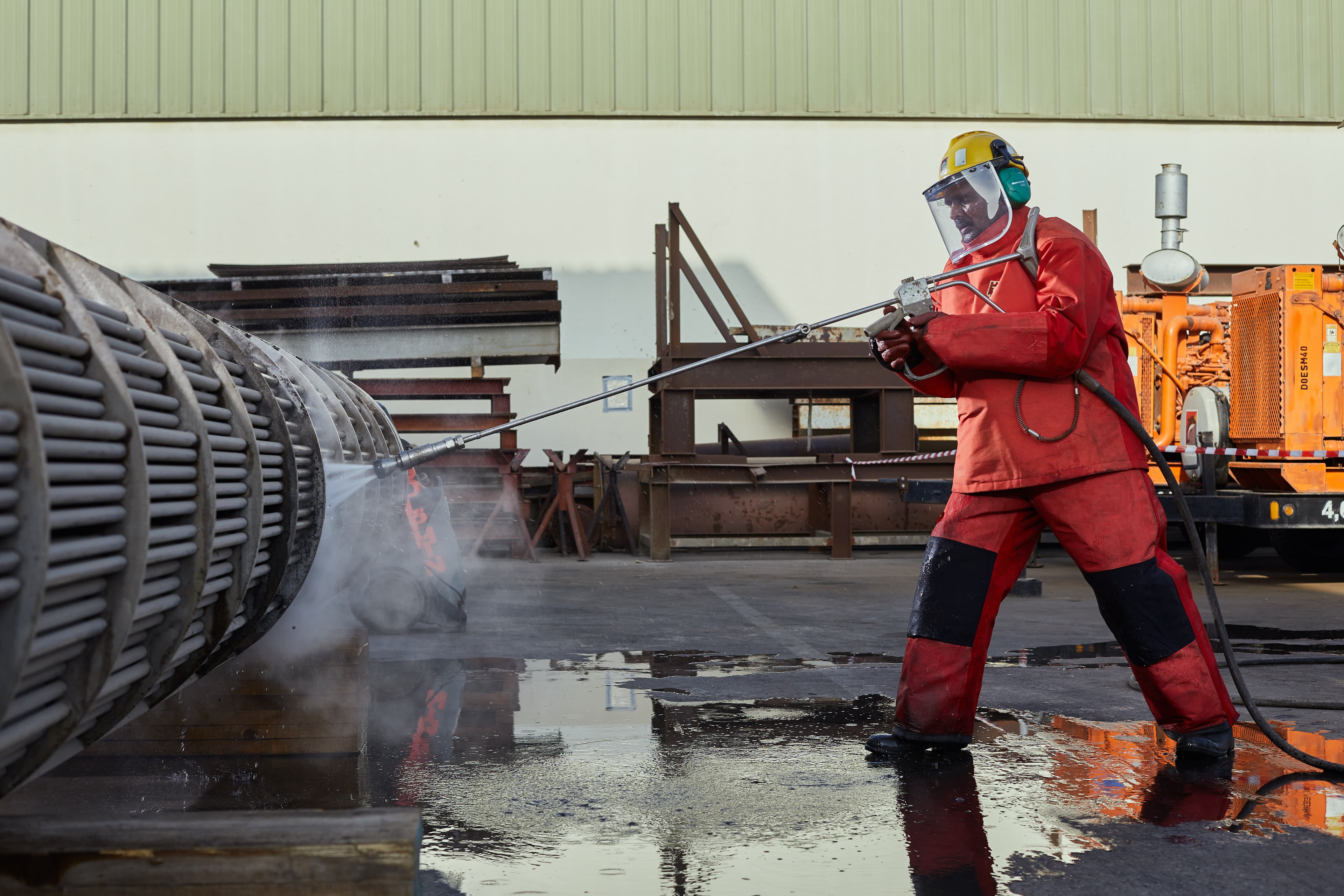
Ultra-high-pressure water — up to 2,800 bar — is delivered through rotating nozzles and rigid or flexible lances that strip deposits from tube bores and external surfaces.
- 1
Deposit type is assessed to set pressure, flow and nozzle selection.
- 2
Bundles are jetted tube-by-tube with rigid or flexible lances; automated indexing ensures no tube is missed.
- 3
Shell-side and external surfaces are jetted with rotating heads.
- 4
Cleanliness is verified visually and, where required, by borescope before sign-off.
Configurations
We Offer
Every variant Dolphin builds — each engineered for a specific duty, not a catalogue default.
Tube ID Lancing
- Best For
- Internal fouling of straight-tube bundles.
- Advantage
- Automated indexing gives verifiable 100% tube coverage.
Shell-side / External Jetting
- Best For
- Bundle exteriors, shells and fin fan bundles.
- Advantage
- Rotating heads clean complex geometry without disassembly.
Workshop Cleaning
- Best For
- Bundles pulled during overhaul or retube.
- Advantage
- Containment, wash-water treatment and inspection in one place.
How to
Choose
| Criterion | Guidance |
|---|---|
| Deposit type | Soft organics, hard scale or coke each demand different pressure, flow and nozzle strategy. |
| Tube metallurgy | Pressure is matched to material — titanium and thin-wall tubes need controlled parameters. |
| Access and location | On-line site cleaning versus pulled-bundle workshop cleaning depends on layout and window. |
| Verification requirement | Borescope inspection and before/after performance data available where duty recovery must be proven. |
Key
Benefits
What sets hydrojetting & tube cleaning from Dolphin apart, in specific and measurable terms.
- 01
Restores design performance
Restores heat exchange performance to near-design values.
- 02
High-pressure capability
Up to 2,800 bar removes hard scale and polymer coke.
- 03
No surface damage
No mechanical or chemical damage to tube surfaces.
- 04
Full documented coverage
Automated lancing delivers consistent, 100% tube coverage.
- 05
Site or workshop execution
Delivered worldwide, on site or in the workshop.
- 06
Controlled wash-water handling
Environmentally controlled wash-water handling.
Technical
Specifications
Design codes, materials and testing scope confirmed for every hydrojetting & tube cleaning order.
| Pressure range | 700 – 2,800 bar |
| Methods | Rigid/flexible lancing · rotating heads · automated indexing |
| Equipment cleaned | S&T bundles · fin fans · plate packs · vessels · pipelines |
| Verification | Visual · borescope · before/after ΔT data |
| Execution | Site crews worldwide · Mussafah workshop |
Why Dolphin for
Hydrojetting & Tube Cleaning
Cleaning informed by engineering
We know what the exchanger should do thermally — cleaning is signed off against performance, not appearance.
Turnaround-proven crews
Multi-unit cleaning campaigns executed inside tight shutdown windows with documented coverage.
One contractor, full scope
Cleaning, inspection, repair and testing under one mobilisation — no interface losses between vendors.
Frequently Asked Questions
No — pressure and nozzle selection are matched to metallurgy and deposit; water jetting removes fouling without the metal loss of mechanical cleaning.
Yes — up to 2,800 bar with appropriate nozzles removes calcite, sulphate scale and polymer coke.
Both. Site crews clean in place or at grade during turnarounds; pulled bundles can be cleaned and inspected at Mussafah.
Visual and borescope verification per tube, plus before/after performance data where required.
Automated lancing typically cleans a mid-size bundle within one shift; campaigns are planned to your outage schedule.
Yes — controlled-pressure external jetting cleans finned surfaces in place without bending fins.
Containment and disposal are handled per site environmental requirements as part of our scope.
Share your exchanger list and outage dates via the RFQ form — we survey, plan and mobilise ahead of the window.
Talk to an Engineer About Hydrojetting & Tube Cleaning
Send your duty requirements or existing datasheet — our engineers will confirm the right configuration and get you a quote.