
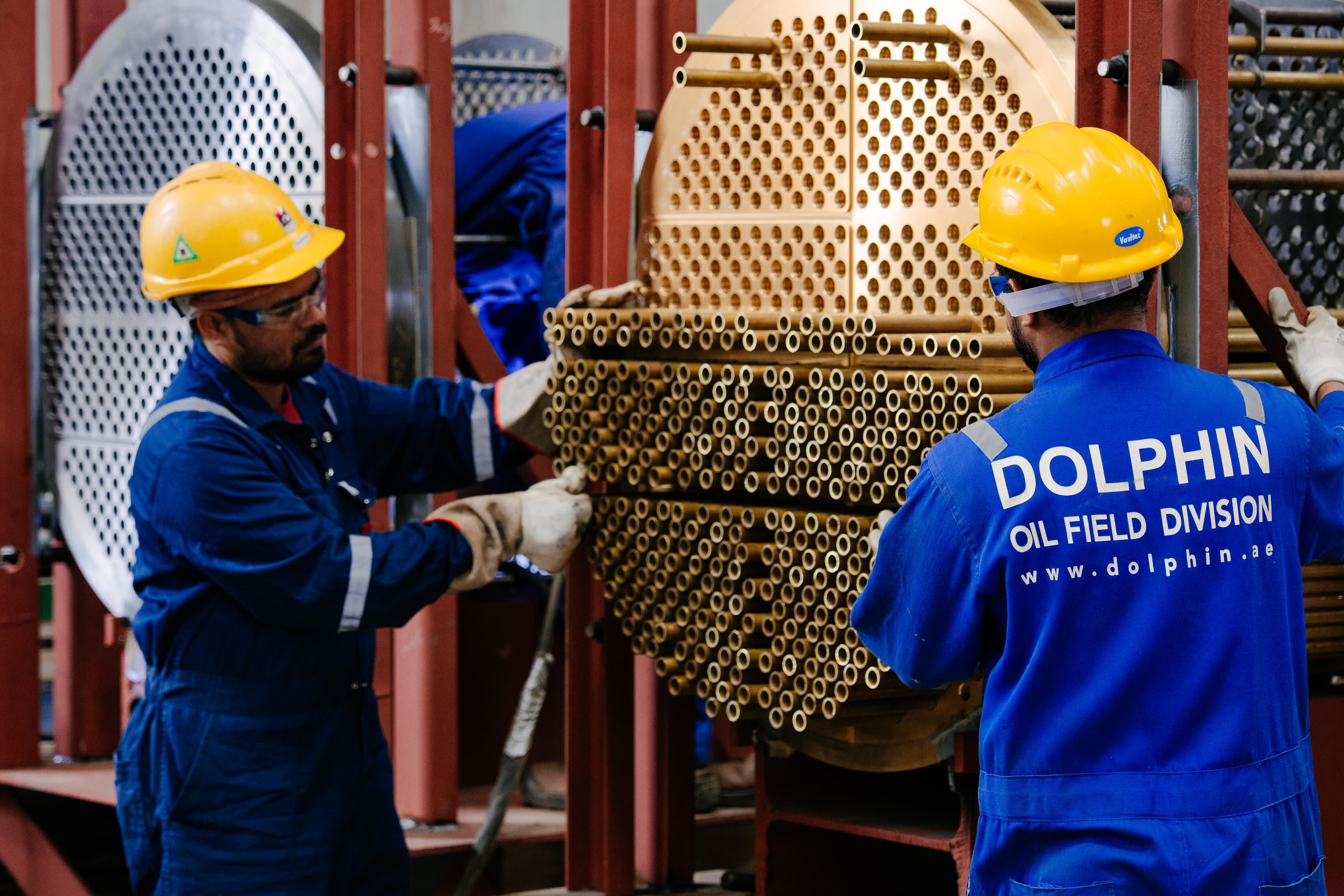
Tube Replacement & Retubing
Full and partial retubing of exchangers and condensers — thousands of tubes replaced to code, inside planned outage windows.
Why This
Matters
The wrong specification here doesn't show up on day one — it shows up as downtime, contamination or wasted energy later.
Asset protection
Plugging is a countdown, not a fix — every plugged tube overloads its neighbours until the bundle can no longer make duty, and the exchanger quietly derates with every subsequent failure.
Process integrity
Aged tubes leak between streams; retubing with upgraded metallurgy resets the corrosion clock, not just the leak — addressing the root cause instead of buying another few months of service.
Operational efficiency
A retube restores 100% of design surface at a fraction of new-equipment cost and lead time, reusing a shell and structure that still has years of service life left in it.
Where It's
Used
Tube Replacement & Retubing in service — sector by sector, application by application.
Power & Energy
Condenser retubing campaigns — thousands of tubes per outage.
View Power & EnergyWater & Desalination
Evaporator and brine heater retubing in titanium and Cu-Ni.
View Water & DesalinationOil & Gas
Bundle retubes with metallurgy upgrades for sour service.
View Oil & GasPetrochemicals
Process exchanger retubing during turnarounds.
View PetrochemicalsMarine & Offshore
Cooler retubing dockside or at the Mussafah workshop.
View Marine & OffshoreSteel & Metallurgy
Cooling system exchanger retubes engineered for thermal cycling.
View Steel & MetallurgyHow It Works
Retubing replaces the heat exchange surface of an exchanger while retaining shell, heads and structure — restoring the unit to as-new thermal and mechanical condition.
- 1
Eddy current / IRIS survey confirms retube necessity and maps tubesheet condition.
- 2
Old tubes are cut, collapsed and extracted without damaging tubesheet holes.
- 3
Tubesheet holes are cleaned, gauged and reconditioned; grooves restored where required.
- 4
New tubes are installed and secured by controlled rolling expansion, seal welding, or strength welding per design.
- 5
Every joint is tested — expansion torque records, air/soap or helium test, then full hydrotest.
Configurations
We Offer
Every variant Dolphin builds — each engineered for a specific duty, not a catalogue default.
Full Retube
- Best For
- Bundles at end of tube life or with widespread wall loss.
- Advantage
- 100% new surface — resets the asset clock at a fraction of replacement cost.
Partial Retube
- Best For
- Localised damage zones (impingement, top-row erosion).
- Advantage
- Targets the failure mechanism without full-bundle cost.
Retube with Upgrade
- Best For
- Recurring corrosion failures.
- Advantage
- Metallurgy upgrade (e.g. brass → titanium) eliminates the root cause.
How to
Choose
| Criterion | Guidance |
|---|---|
| Tube test results | Eddy current wall-loss mapping decides full versus partial scope — data first, always. |
| Failure mechanism | Erosion, corrosion or vibration each point to different tube materials and support fixes. |
| Tube-to-tubesheet joint | Rolled, seal-welded or strength-welded — set by pressure, fluid hazard and original design. |
| Outage window | Tube stock pre-ordered and crews pre-planned so the window is spent retubing, not procuring. |
Key
Benefits
What sets tube replacement & retubing from Dolphin apart, in specific and measurable terms.
- 01
Full surface restored
Restores 100% of design heat exchange surface.
- 02
Fraction of replacement cost
A fraction of the cost and lead time of new equipment.
- 03
Metallurgy upgrades
Engineered to eliminate recurring failures.
- 04
Controlled expansion
Recorded wall-reduction — no over-rolled joints.
- 05
Helium leak testing
Available for critical services.
- 06
Code-compliant documentation
Site and workshop execution, fully documented.
Technical
Specifications
Design codes, materials and testing scope confirmed for every tube replacement & retubing order.
| Tube materials | CS · SS · Duplex · Brass · Cu-Ni · Titanium |
| Joint types | Roller expanded · seal welded · strength welded |
| Campaign size | Single tubes to 5,000+ tube condensers |
| Testing | Torque-controlled rolling · air/soap · helium · hydrotest |
| Execution | Site crews worldwide · Mussafah workshop |
Why Dolphin for
Tube Replacement & Retubing
Proven large-campaign record
Thousands-of-tubes condenser and desalination retubes delivered inside planned outages.
Manufacturer’s joint quality
The same qualified procedures we use on new ASME bundles govern every replacement joint.
Material stock and speed
Established supply relationships and Mussafah logistics put tubes on site when the window opens.
Frequently Asked Questions
When shell and structure remain sound — a retube restores full performance for typically 30–50% of replacement cost with far shorter lead time.
As a rule of thumb, beyond about 10% plugged the thermal and hydraulic penalties make retubing the economic choice — confirmed against your duty margin.
Yes — upgrades such as brass to titanium are common and are engineered for tubesheet compatibility and thermal design impact.
Yes — condensers and large exchangers are retubed in place by mobile crews with the same controlled processes as the workshop.
Recorded expansion torque, air/soap or helium leak testing per joint, then full code hydrotest.
A mid-size bundle typically takes 1–3 weeks; large condenser campaigns are planned in shifts to fit the outage.
Yes — certified tube stock with EN 10204 3.1 material certificates, pre-ordered ahead of your window.
Send tube test data or arrange our eddy current survey; we return scope, schedule and tube procurement plan.
Talk to an Engineer About Tube Replacement & Retubing
Send your duty requirements or existing datasheet — our engineers will confirm the right configuration and get you a quote.